Article: Red Light Therapy Device Buying Guide: Specifications to Compare
Red Light Therapy Device Buying Guide: Specifications to Compare
Red Light Therapy Device Buying Guide: Specifications to Compare
Red light therapy devices come in many formats, from compact panels and flexible wraps to face masks and larger full-body systems. Although they may use similar marketing language, their dimensions, wavelengths, light output, coverage, controls, positioning requirements, and intended uses can differ considerably.
The best device is not automatically the largest, most powerful, or most expensive option. It is the product that fits your intended application, available space, preferred setup, manufacturer-supported instructions, and budget.
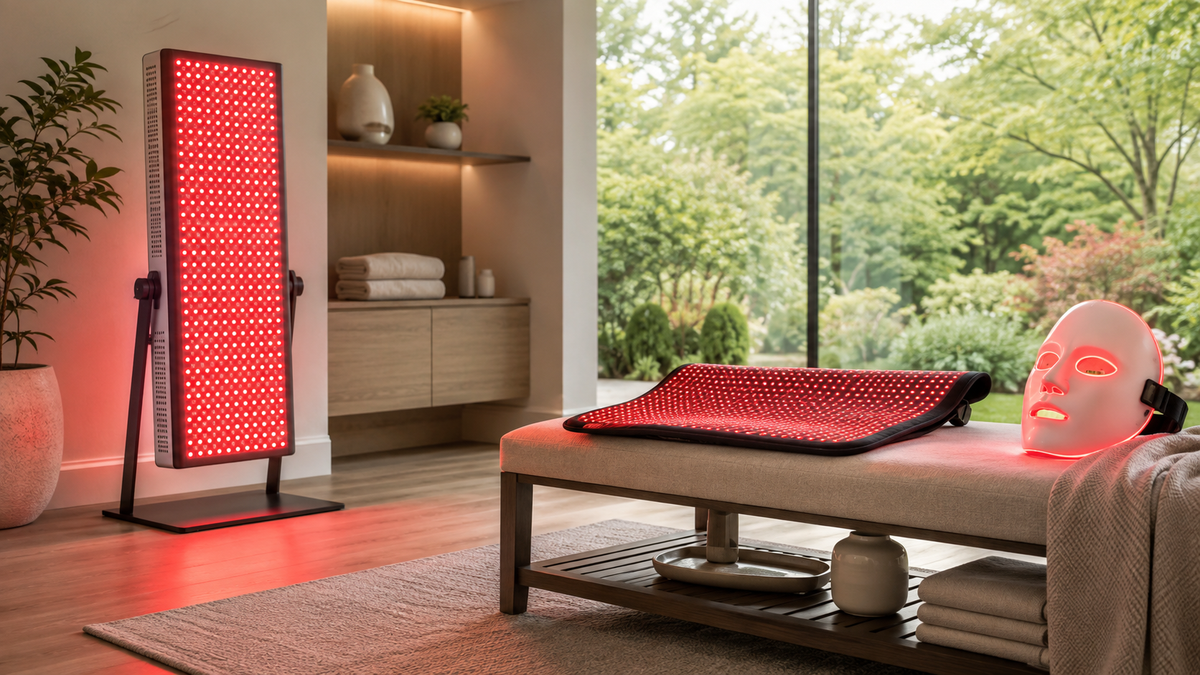
Prime Regeneration currently offers red light therapy panels, flexible pads, cordless wraps, face masks, and larger systems designed for different home-use setups.
This guide explains the main specifications to compare before choosing a red light therapy device.
What to Compare Before Buying a Red Light Therapy Device
Before comparing individual models, consider these questions:
-
What area do you want the device to cover?
-
Do you want a stationary or portable product?
-
Will you use it while standing, sitting, lying down, or moving around?
-
How much space is available?
-
Does the device require a stand or mounting system?
-
Which wavelengths does the manufacturer identify?
-
At what distance is the light-output measurement provided?
-
Can individual wavelength channels be controlled separately?
-
What eye-safety instructions apply?
-
What accessories are included?
-
What warranty and return terms apply?
-
Is the product marketed for general wellness or for a specific FDA-cleared intended use?
These questions are more useful than comparing products solely by LED count, maximum output, or price.
Start With the Device Format
The first step is choosing a format that fits how and where you expect to use the device.
Compact and Portable Panels
A compact panel may be appropriate for:
-
Smaller rooms
-
Desk or tabletop placement
-
Travel between rooms
-
Targeted coverage
-
Customers who do not need a permanent installation
-
Lower initial equipment costs
Review whether the device includes a tabletop stand, hanging hardware, door mount, floor stand, or carrying case. A small panel that requires additional accessories may use more space or cost more than expected.
Also compare the illuminated coverage area rather than relying only on the exterior dimensions of the panel.
Large and Full-Body Panels
Larger panels are designed to illuminate a broader area from one position. They may fit well in:
-
Home gyms
-
Dedicated wellness rooms
-
Bedrooms
-
Offices
-
Recovery spaces
-
Areas with sufficient wall or floor clearance
A larger panel may reduce the need to reposition the device frequently, but it also requires more floor or wall space.
Before purchasing, confirm:
-
Panel dimensions
-
Product weight
-
Stand dimensions
-
Recommended positioning distance
-
Electrical requirements
-
Ventilation clearance
-
Whether the stand is included or sold separately
-
Whether horizontal positioning is supported
Do not assume that every large panel automatically provides complete head-to-toe coverage for every user. Coverage depends on the panel size, user height, positioning, beam distribution, and manufacturer-supported distance.
Flexible Pads and Wraps
Flexible pads and wraps are designed to sit closer to the body than freestanding panels.
They may be suitable for customers who want:
-
A portable device
-
Flexible placement
-
A product that can be stored between uses
-
Cordless operation, when available
-
A smaller footprint than a standing panel
Compare the pad dimensions, flexibility, fastening method, battery life, charging time, cable placement, controller, and manufacturer instructions.
Some pads are designed to lie across an area, while others are designed to wrap around it. Do not fold, compress, sit on, or cover a flexible light device unless the manufacturer specifically permits that use.
Red Light Therapy Masks
A face mask provides a wearable format designed around the facial area.
When comparing masks, review:
-
Wavelengths
-
Number and placement of LEDs
-
Mask weight
-
Fit and adjustability
-
Eye openings
-
Eye-protection instructions
-
Corded or rechargeable operation
-
Controller settings
-
Session timer
-
Cleaning instructions
-
Included storage case
-
Manufacturer-identified intended use
A higher LED count does not automatically mean that one mask is better than another. Fit, light placement, wavelength specifications, controls, instructions, and comfort are also important.
Multi-Panel and Larger Systems
Some systems combine multiple panels or use a larger overhead, vertical, or horizontal configuration.
These systems may offer broader coverage but require careful planning for:
-
Room dimensions
-
Ceiling height
-
Floor space
-
Assembly
-
Electrical access
-
Weight
-
Product clearance
-
User entry and exit
-
Delivery access
-
Storage
-
Maintenance
Measure the intended location and delivery path before ordering. Confirm whether professional assembly or electrical work is required for the exact model.
Compare the Wavelength Specifications
Wavelengths are commonly listed in nanometers, abbreviated as nm.
A device may offer:
-
One red-light wavelength
-
Multiple red-light wavelengths
-
Near-infrared wavelengths
-
A combination of red and near-infrared light
-
Additional light types, depending on the product
The number of wavelengths should not be treated as a simple quality score. More wavelengths do not automatically make a device better for every customer.
Instead, ask:
-
Are the exact wavelength values listed?
-
Can the wavelength channels be controlled separately?
-
Does the manufacturer explain the device’s intended application?
-
Are all wavelengths active at the same time?
-
Can red light be used without near-infrared light?
-
Does the device include additional light types?
-
Does the manual provide instructions for each available setting?
The FDA’s draft guidance for photobiomodulation devices identifies wavelength, irradiance, fluence, output mode, spot size, and pulsing parameters as separate characteristics that may affect device performance. This supports comparing the complete specification set rather than choosing a product based on wavelength alone.
Understand Irradiance
Irradiance describes the amount of light power received over a given surface area. It is commonly listed in milliwatts per square centimeter, or mW/cm².
An irradiance number is only useful when the manufacturer also explains how and where it was measured.
Look for:
-
The measurement distance
-
Whether the number is an average or peak measurement
-
Which wavelength settings were active
-
Whether the measurement applies to the center or the full illuminated area
-
Whether independent testing information is available
-
The manufacturer-supported operating distance
The FDA defines irradiance as light power received by a surface per unit area and notes that PBM outcomes may depend on multiple factors, including wavelength, irradiance, fluence, pulsing parameters, and beam size.
A larger irradiance number does not automatically mean a device will be the better choice. It should be evaluated alongside distance, session instructions, coverage, thermal management, and intended use.
Avoid comparing two irradiance numbers when they were measured at different distances or under different operating conditions.
Understand Fluence or Radiant Dose
Fluence—sometimes called radiant dose or energy density—refers to the amount of light energy delivered over a surface area.
It combines output and exposure time. For example, changing the distance, intensity, or duration may change the amount of energy reaching the illuminated area.
Consumers should not create their own exposure calculations based only on a specification sheet. Follow the distance, duration, settings, and frequency provided by the manufacturer for the exact device.
When comparing products, look for clear instructions rather than assuming that a larger dose or longer session is better.
Compare Coverage Area
Coverage area is different from product size.
A panel’s exterior dimensions tell you how large the equipment is, but not necessarily how much of the user will be evenly illuminated at the recommended distance.
Compare:
-
Physical panel dimensions
-
Illuminated area
-
Recommended distance
-
LED arrangement
-
Beam angle, when provided
-
User height
-
Intended position
-
Whether repositioning is required
A compact panel may work well for a smaller area but require multiple positions for broader coverage. A larger panel may cover more area from one position but require more installation space.
Choose based on the area you actually want to illuminate—not simply the largest panel you can afford.
Review the Recommended Positioning Distance
The recommended distance affects coverage and light intensity.
Before buying, verify:
-
How far the user should be from the device
-
Whether the distance changes by setting
-
Whether direct skin exposure is required
-
Whether the user should stand, sit, or lie down
-
Whether the product can be used horizontally
-
Whether a stand or mounting accessory is needed
-
Whether the product includes markings or guidance for positioning
Do not assume that standing closer is better. Use the device only at the distances supported by its manufacturer instructions.
Compare Timers, Controls, and Settings
Device controls can range from a basic power switch to a digital controller with multiple channels.
Features may include:
-
Session timer
-
Adjustable intensity
-
Separate wavelength controls
-
Continuous or pulsed settings
-
Remote control
-
Touchscreen
-
Mobile application
-
Preset programs
-
Saved settings
-
Automatic shutoff
-
Rechargeable battery
More settings are not always necessary. A simple controller may be easier for someone who wants repeatable operation, while separate wavelength and intensity controls may appeal to someone who wants more flexibility.
Confirm that the manual clearly explains each control. Do not use a setting simply because it produces the highest output.
Review Mounting and Stand Options
The mounting system can affect how convenient the device is to use.
Common options may include:
-
Tabletop stand
-
Floor stand
-
Rolling stand
-
Wall mount
-
Door mount
-
Hanging system
-
Horizontal stand
-
Overhead frame
Verify whether the mounting equipment is included.
A product image may show a stand that is optional rather than standard. Review the included-components list and calculate the complete setup cost before ordering.
Also confirm:
-
Stand footprint
-
Height adjustment
-
Angle adjustment
-
Weight capacity
-
Locking wheels
-
Horizontal compatibility
-
Assembly requirements
-
Required wall construction or hardware
The best mounting option is the one that lets you position the device according to the manufacturer instructions without creating an unstable or obstructed setup.
Check Electrical and Room Requirements
Before placing a red light therapy device in a home wellness space, review:
-
Input voltage
-
Plug type
-
Power consumption
-
Outlet location
-
Cord length
-
Grounding instructions
-
Extension-cord restrictions
-
Ventilation clearance
-
Operating-temperature range
-
Humidity restrictions
-
Storage requirements
Do not assume every panel can be used in a bathroom, steam room, sauna, or outdoor space.
A red light therapy device should never be placed inside a sauna, steam enclosure, wet room, or other high-temperature or high-humidity environment unless the manufacturer explicitly approves the device for that environment.
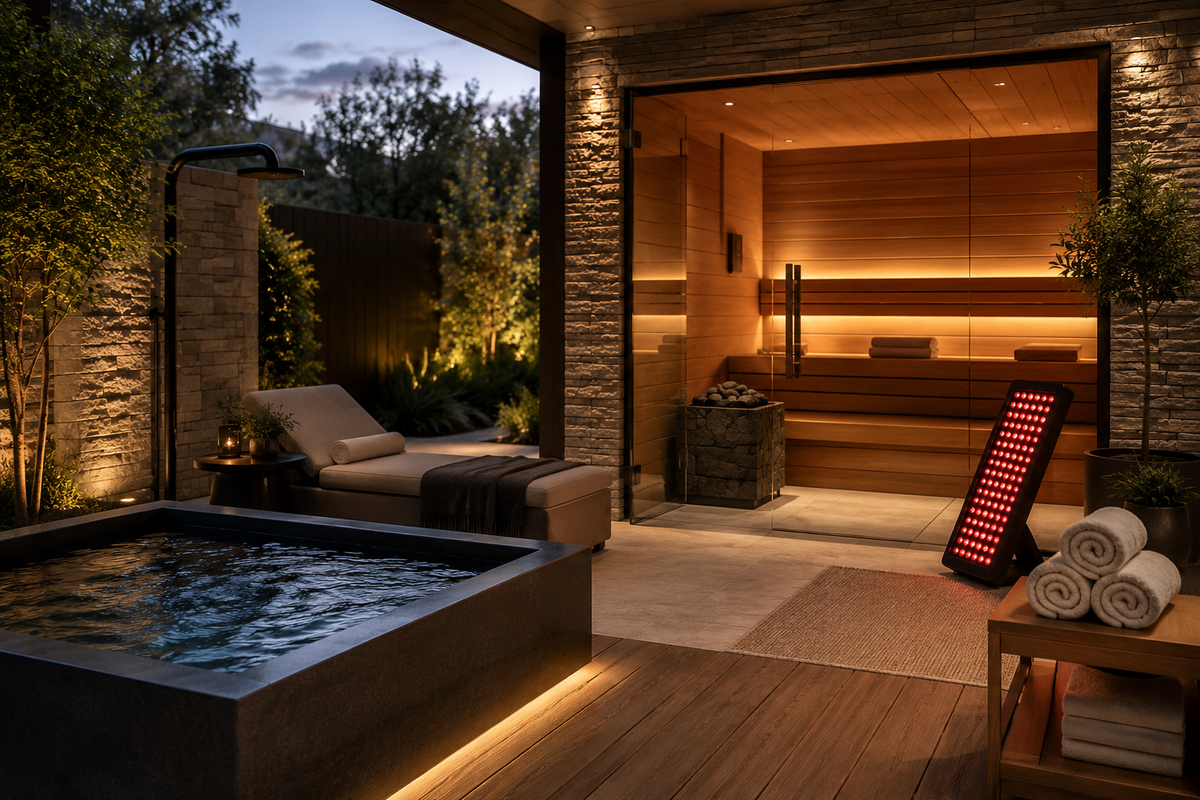
A red light panel may be positioned in a separate wellness room near a sauna or cold plunge, but it must still be operated according to its own clearance, moisture, electrical, and temperature instructions.
Follow the Eye-Safety Instructions
Bright visible light and near-infrared output require attention to the manufacturer’s eye-safety guidance.
Depending on the device, the instructions may require:
-
Protective eyewear
-
Closed eyes
-
Avoiding direct viewing of the LEDs
-
Maintaining a specific distance
-
Limiting use near the eyes
-
Using built-in eye shields
-
Following device-specific precautions
The FDA’s draft PBM guidance identifies potential ocular exposure as a safety consideration and states that measures such as protective eyewear or other safeguards may be appropriate when a device could expose the eyes above permissible levels.
Do not assume that every device has the same eye-safety requirements. Follow the manual supplied with the exact product.
People with eye conditions, light sensitivity, or medications that may increase photosensitivity should consult an appropriate healthcare professional before use.
For more information, read the Red Light Therapy Safety Guide: Risks, Precautions, and At-Home Use Tips.
Understand FDA Terminology
FDA terminology is frequently misunderstood in red light therapy marketing.
FDA Registered
An establishment may register with the FDA and list devices, but registration does not mean that the FDA reviewed, cleared, approved, certified, or endorsed a particular product.
The FDA specifically states that registration and listing do not indicate approval, clearance, or authorization, and the agency does not issue device-registration certificates.
Be cautious when a listing uses phrases such as:
-
FDA registered
-
FDA certified
-
FDA registered facility
-
Manufactured in an FDA-registered facility
These statements do not establish that the exact product has FDA clearance for a specific intended use.
FDA Cleared
Many Class II medical devices reach the U.S. market through the FDA’s 510(k) process.
A 510(k) clearance means the FDA determined that the submitted device was substantially equivalent to a legally marketed predicate device for its identified intended use. Clearance applies to the exact device and its cleared labeling—not automatically to every product made by the same manufacturer.
When a product is advertised as FDA cleared, look for:
-
The exact device name
-
Manufacturer name
-
510(k) number
-
Product code
-
Cleared intended use
-
Matching model information
The information can be checked through the FDA’s official medical-device databases.
FDA Approved
“FDA approved” is not interchangeable with “FDA cleared.”
Do not describe a product as FDA approved unless the exact product has received the applicable form of FDA approval and the manufacturer documentation supports that wording.
When discussing a 510(k) device, the appropriate wording is generally FDA cleared, not FDA approved.
Compare the Intended Use
Two products with similar wavelengths or similar appearances may have different intended uses.
Review the manufacturer’s labeling for:
-
Intended user
-
Intended application
-
Areas of use
-
Operating environment
-
Warnings
-
Contraindications
-
Precautions
-
Session instructions
-
Eye protection
-
Cleaning
-
Maintenance
-
Storage
Some light-emitting products are marketed only for general wellness, while other products may be regulated medical devices with a specific cleared intended use. FDA’s draft PBM guidance distinguishes certain low-risk general-wellness products from Class II PBM medical devices covered by the guidance.
Do not transfer a claim from one cleared product to another device simply because both emit red or near-infrared light.
For a broader discussion about research and realistic expectations, read Does Red Light Therapy Work? The Honest Truth.
Review Construction and Everyday Usability
Specifications matter, but the device also needs to be practical enough to use consistently.
Consider:
-
Product weight
-
Handles
-
Wheels
-
Cord storage
-
Controller placement
-
Stand stability
-
Surface materials
-
Cleaning instructions
-
Mask or wrap comfort
-
Battery life
-
Charging method
-
Noise from cooling fans
-
Storage requirements
-
Ease of repositioning
A device that is difficult to assemble, move, position, or store may not fit your space even when its technical specifications look impressive.
Check What Is Included
Review the included-components section carefully.
Depending on the model, the purchase may or may not include:
-
Power supply
-
Controller
-
Remote
-
Protective eyewear
-
Tabletop stand
-
Floor stand
-
Wall hardware
-
Door mount
-
Horizontal stand
-
Carrying case
-
Connecting cables
-
Rechargeable battery
-
User manual
-
Cleaning cloth
Never assume that accessories shown in product photography are included.
Add the price of required accessories when comparing the true cost of two devices.
Compare Warranty, Returns, and Support
Before ordering, review:
-
Warranty duration
-
Parts and labor coverage
-
Controller coverage
-
LED coverage
-
Battery coverage
-
Exclusions
-
Registration requirements
-
Transferability
-
Return period
-
Restocking fees
-
Opened-product restrictions
-
Return-shipping responsibility
-
Damage-reporting deadlines
Personal-use wellness products may have return restrictions after they are opened or used. Read the retailer and manufacturer policies before removing packaging or operating the product.
Also confirm who handles warranty claims: the retailer, manufacturer, distributor, or another service provider.
Red Light Therapy Device Buying Checklist
Use this checklist when comparing products:
-
Device format
-
Physical dimensions
-
Product weight
-
Coverage area
-
Wavelengths
-
Separate wavelength controls
-
Irradiance and measurement distance
-
Manufacturer-supported positioning
-
Session timer
-
Intensity settings
-
Pulsed or continuous modes
-
Included stand or mount
-
Optional accessories
-
Electrical requirements
-
Ventilation clearance
-
Eye-safety instructions
-
Operating environment
-
Intended use
-
FDA terminology
-
Cleaning requirements
-
Warranty
-
Return policy
-
Shipping timeline
-
Customer support
A product should provide enough documentation for you to understand how it is installed, positioned, operated, cleaned, and maintained before you purchase it.
Frequently Asked Questions
Is a higher irradiance always better?
No. Irradiance must be considered along with measurement distance, coverage, wavelength, session instructions, thermal management, and intended use.
Do not compare irradiance numbers measured at different distances as though they were directly equivalent.
Are more wavelengths better?
Not automatically.
A greater number of wavelengths may provide additional settings, but it does not guarantee that a device will be more suitable for your intended use. Review the exact wavelengths, controls, labeling, instructions, and manufacturer-supported application.
Is a larger red light therapy panel better than a smaller one?
A larger panel may provide broader coverage, but it requires more room and may cost more.
A smaller device may be more practical for targeted use, portability, storage, or a limited space. Choose based on the coverage and setup you need.
Should I choose a panel, pad, wrap, or mask?
Choose based on the area you want to illuminate and how you prefer to use the device.
Panels provide non-contact illumination from a supported distance. Pads and wraps use closer placement and are easier to store. Masks are shaped for facial use. Larger systems provide broader coverage but require more space.
Can I use a red light therapy device every day?
Frequency is device-specific. Follow the manufacturer’s instructions for session duration, frequency, distance, settings, and rest periods.
Do not assume that longer or more frequent use will produce better results.
Can I use red light therapy inside a sauna?
Only when the exact red light device is specifically designed and approved by its manufacturer for use under the sauna’s temperature, humidity, and electrical conditions.
A standard red light therapy panel, mask, pad, or wrap should not be placed inside a sauna or steam enclosure unless its documentation explicitly permits that use.
What does FDA cleared mean?
FDA clearance through the 510(k) process means the device was found substantially equivalent to a legally marketed predicate device for its stated intended use.
Clearance is specific to the identified product and labeling. It does not automatically apply to every model from the same manufacturer.
Does Prime Regeneration install red light therapy equipment?
Prime Regeneration is an online equipment retailer and does not provide local installation services.
Many portable devices require only manufacturer-directed setup. Larger stands, multi-panel systems, wall installations, or electrical configurations may require additional assembly or professional assistance.
Can Prime Regeneration help me compare products?
Prime Regeneration can help customers compare available product formats, dimensions, wavelengths, coverage, controls, included accessories, mounting options, warranties, and manufacturer documentation.
Choosing the Right Red Light Therapy Device
The right red light therapy device should fit your intended application, room, positioning preference, coverage needs, electrical access, storage requirements, and budget.
Do not choose based on one large specification alone.
Compare the complete product:
-
Format
-
Wavelengths
-
Irradiance
-
Measurement distance
-
Coverage
-
Controls
-
Mounting
-
Electrical requirements
-
Eye-safety guidance
-
Intended use
-
Warranty
-
Return policy
Most importantly, choose a device with clear manufacturer documentation and instructions that you can realistically follow in your home.
Shop Red Light Therapy Devices at Prime Regeneration
Explore red light therapy panels, masks, flexible pads, wraps, and larger systems for home wellness spaces.
Shop Red Light Therapy Devices
Important Notice
This article is provided for general informational and product-comparison purposes only. It does not provide medical advice, diagnosis, treatment recommendations, or individualized usage protocols.
Product specifications, FDA status, intended use, availability, pricing, accessories, warranties, and manufacturer instructions may change. Review the current product page and official manufacturer documentation before ordering.
Unless the exact product page identifies an FDA-cleared intended use, products offered by Prime Regeneration are presented for general wellness use and are not intended to diagnose, treat, cure, or prevent any disease or medical condition.
Consult a qualified healthcare professional before using a red light therapy device if you are pregnant, have an eye or skin condition, have light sensitivity, are recovering from surgery or injury, have a medical concern, or take medication that may increase photosensitivity.